
To follow and understand this example, it is necessary to download the Gantt charts showing all project activities and dates.
The Collapsed as Built technique requires modelling the as-built programme. Most planning software, in this case Primavera P6, stores as-built dates as fixed events in time, which means that completed activities are not considered in the critical path calculation or in the project finish date.
For that reason, it is necessary to create a schedule with the as-built dates but without progress, so that the dates and critical path can be recalculated once the delay events have been collapsed.
In this example, a wind farm with three main stakeholders will be analysed. On one side, there is the owner and developer, who is responsible for defining the location of the wind turbines and carrying out the necessary earthworks. The owner has contracted a wind turbine manufacturer, which must manufacture, ship and install all wind turbines and acts as the party with overall responsibility for the project. The manufacturer has in turn subcontracted the installation works to a contractor, which will install and commission all the machines.
The analysis will be carried out from the manufacturer's point of view against the contractor. The analysis would be completely different if it were carried out from the manufacturer's point of view against the owner.
Creating the as-built model with activities without progress is the first and most complex step. It also requires a large volume of reliable information and a high level of Primavera knowledge. In this example, it will be assumed that no acceleration plan has been requested and that there are no change orders to execute.
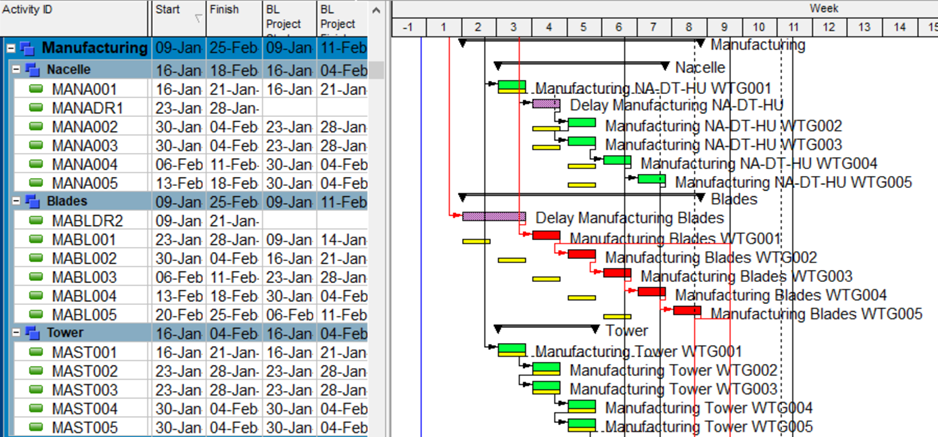
Once the model has been created with the delay events, the duration of the delays that are the responsibility of one of the parties is changed to zero in order to calculate the earliest completion date if those delays had not occurred. In this case, by using a Global Change or by filtering and applying Fill Down, we will set the duration of all created Delay activities to zero because they are delays that are the manufacturer's responsibility, except for those delays affecting installation, which correspond to adverse weather and therefore force majeure.
Once the duration has been changed to zero, the schedule is recalculated and a new completion date is obtained, in this case 29 April. By calculating the difference between the actual completion date, 15 May, and the date obtained without the delays that are the manufacturer's responsibility, the excusable compensable delay is obtained: 16 calendar days.
The same process must be carried out for the contractor's delays. In this case, we have a custom column where the contractual durations of all installation activities have been stored. By applying a Global Change, the durations of the activities that are the contractor's responsibility are changed and the schedule is recalculated, obtaining the new completion date of 5 May. This analysis shows when the project would have been completed if the contractor had complied with the contractual durations.
It is very important to consider possible sequence changes in the activities due, for example, to lack of personnel by the contractor, and to consider that sequence change as a delay that is the contractor's responsibility. For that reason, the complexity of this method lies in modelling the as-built programme, where the subjective judgement and perfectionism of the specialist carrying out the analysis come into play.
The difference between 5 May and 15 May is 10 non-excusable, non-compensable days for the contractor.
Of the 33 days of delay, 16 are the manufacturer's responsibility, 10 are the contractor's responsibility and therefore 7 would be excusable non-compensable delays caused by force majeure events or concurrent delays.