
A delay is any event or situation that prevents the dates of activities agreed in a contract signed by two parties from being maintained. Given the complexity of today's projects, construction delays are common because permits, personnel, materials, machinery, activities and design changes must be coordinated, all under unpredictable circumstances. These conditions have made completing projects on time and within cost extremely difficult.
Because of the large amount of resources required to execute a construction project, delays generate major cost overruns and these costs must be borne by one of the parties. In some cases, this creates tensions and disputes that require penalties to be applied, scope changes to be made, or recovery or acceleration plans to be prepared.
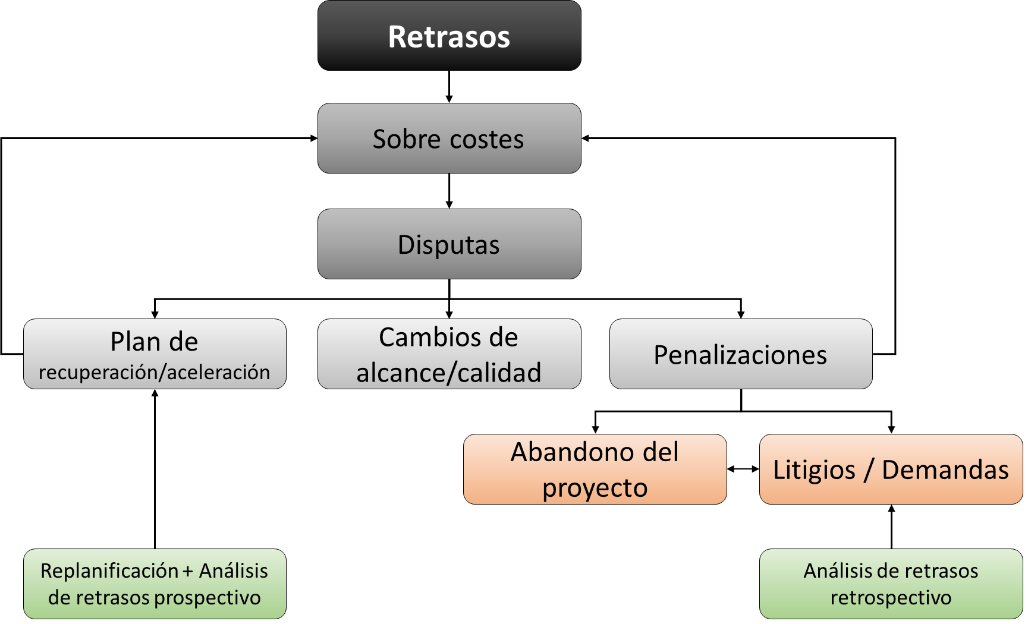
Delays in construction projects generate a cost overrun that one of the parties must bear, either through the application of penalties, higher cost of remaining on site or loss of income.
A negotiation period is normally opened in which responsibility for the delays is determined. This may lead to recovery or acceleration plans, depending on who covers the costs, scope changes or penalties.
Types of construction delays
Delays are classified into different types:
- Critical or non-critical. Critical delays are those that affect project completion or one of its penalised milestones. Non-critical delays can become critical if they continue over time or if there is a change in strategy.
- Concurrent or non-concurrent. A concurrent delay is one that occurs at the same time as another delay event and both affect the critical path.
- Excusable non-compensable, excusable compensable or non-excusable non-compensable.
This last category defines who must bear the costs. However, delay classification is complex and in many cases the result depends on the methodology and judgement of the specialist applying it.
Extensions of time
Contracts usually allow an extension of the time for executing the project when the delay is not the contractor's responsibility, in the circumstances and subject to the conditions set out in the contract. Once the delay is evident or likely to occur, the contractor must notify in writing which event has caused or will cause a delay, complying with the applicable deadlines and procedure. If entitlement to an extension of time is established and recognised under the contract and applicable law, the project completion date will be adjusted.
The usual events that may give rise to extensions of time are:
- Project variations instructed by the client.
- Adverse weather conditions.
- Force majeure events, such as pandemics, earthquakes, wars or strikes.
- Lack of timely information from the client.
- Delay in the delivery of materials, components or areas outside the contractor's scope.
Submitting extension of time claims can be complicated. There are usually multiple delays or concurrent delays, some of which may be the contractor's responsibility and others not.
An essential part of making this type of claim is the availability of a large amount of quality information. The claim must demonstrate the causal relationship between the event and the delay.
Costs
Direct costs
Direct costs are directly linked to the execution of work units and are remunerated through their certification. They are therefore considered not to be affected by the delay in project completion. They usually consist of direct labour, materials, machinery and auxiliary resources. The particular feature of these costs is that, because they are directly associated with project execution, they do not depend on the duration of the works.
In an extension of time claim, direct costs remain constant. Only in claims for loss of productivity, or disruption, is it possible to claim higher direct costs.
Indirect costs
Indirect costs are those not directly linked to execution of the works, but necessary for their proper progress. Indirect costs include the cost of site offices, communications, warehouses, workshops, technical and administrative personnel assigned exclusively to the works, among others.
Therefore, during project development, technical and administrative personnel expenses are incurred that are necessary to organise and direct the works in proportion to the activities.
It is necessary to determine whether these costs are reimbursable to the contractor. To do so, a delay analysis must be carried out to determine the compensable excusable delay, the excusable delay and the non-excusable delay.
General expenses, profit and revision
General expenses associated with project execution are normally distinguished from indirect costs because they are not linked to execution of the works, but to the general structure of the company.
They are therefore expenses derived from the cost of maintaining the company's necessary activity during the period set for execution of the works. General expenses include company head office expenses, software licences, indirect personnel not assigned exclusively to the project, marketing and representation expenses, among others.