
The disruption suffered by the contractor must be demonstrated through analytical methods and techniques that allow the loss of productivity to be evaluated and quantified. Disruption analysis cannot be limited only to the difference between what happened and what was initially planned.
The objective of carrying out a disruption analysis is to evidence the lost productivity and therefore the additional costs and losses caused by events that are the employer's responsibility.
Many of the causes that lead to low productivity are the contractor's responsibility and therefore do not justify compensation. Some examples are:
- Lack of coordination between subcontractors
- Poor supervision or planning
- Rework due to defects
- Excessively optimistic planning
- Lack of resources
- Mechanical problems in the contractor's machinery and tools.
The SCL Delay and Disruption Protocol delay disruption protocol explains different methods for calculating the loss of productivity resulting from different disruptive events.
- Productivity-based methods. These are based on actual or theoretical measurements of productivity. They seek to measure the loss of productivity in the resources used and then assign a price to that loss.
- Cost-based methods. These are based on the analysis of planned and actual resource expenses or costs. They seek directly to determine the difference between actual cost and planned cost without first measuring productivity losses in the resources used.
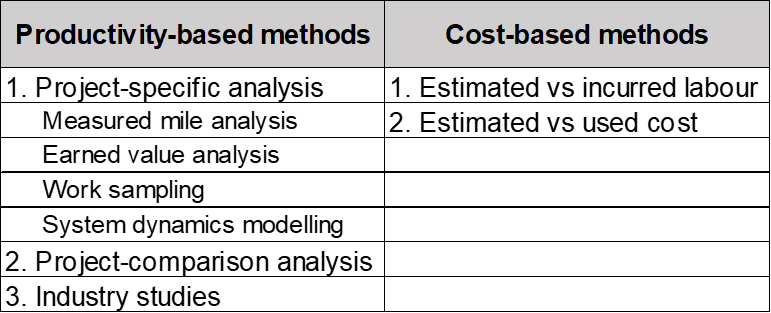
Productivity-based methods
There are three general categories of productivity-based methods, listed below in order of preference because of their decreasing reliability and general acceptance:
Project-specific analysis
Measured mile analysis: Compares the productivity achieved in areas or periods affected by disruptive events with the productivity achieved in similar activities during periods not affected by those events. This method is widely accepted; however, it is complex and requires a large amount of documentation, as well as periods not affected by any event.
Earned value analysis: Identifies the man-hours reasonably included in the budget to complete certain activities and compares them with the actual man-hours used to complete those activities. Specialised software is commonly used to assist in calculating earned value for each activity.
Work sampling: Based on contemporary records of direct observations of work and events to determine productivity.
Dynamic modelling system: Based on the analysis of a simulation using specific software that creates a detailed model of the affected project and simulates it again without the disruption events in order to compare the results. This approach is essentially the Collapsed as Built method, but more detailed and focused only on the disruption events that are the client's responsibility. The strength of the conclusions derived from this analysis depends on:
- Accuracy of progress and event data and records
- Reasonableness and experience of the analyst when establishing the model
- Transparency of the analytical process carried out by the specialised software.
Given these difficulties and the complexity and cost involved in carrying out this analysis, it is not used as often as other methods for calculating loss of productivity.
Similar project comparison analysis
These methods are used when there are not enough records available to carry out a project-specific study. Productivity in the affected project is compared with similar projects within the same industry where the disruption events did not occur.
Industry studies
When there is not enough contemporary documentation for a project-specific study, or comparison studies are not available, an estimate of loss of productivity based on data developed from industry-wide research studies can be used. Factors generated from these studies are applied to the actual resource losses in the affected project to determine whether the measured loss level coincides with the factors determined in those studies. It is important to note that these methods vary in reliability and depend on the availability of relevant records and data.
Conclusion
The suitability of these methods depends on the available records, the circumstances of the case and the applicable contract and procedure. Where reliable data are available, project-specific analyses are generally preferable because they assess the work actually carried out.