
To follow and understand this example, it is necessary to download the Gantt charts showing all project activities and dates.
Gantt-APvsAB Gantt-Baseline
A project has been created in Primavera P6 with the basic activities required to monitor and control a wind farm, and the schedule has been analysed using the as-planned vs as-built technique in order to determine responsibility for the delay that occurred. It will be assumed that no acceleration plan has been requested and that there are no change orders to execute.
The delay analysis is carried out from the point of view of one of the parties, assuming that the other party is responsible for the remaining activities. For example, from the point of view of a contractor responsible for civil works and construction on a project, design is the responsibility of the promoter or owner, even if it is subcontracted to an external designer, because the contract is signed between the contractor and the promoter.
In this case, there are three main stakeholders. On one side, there is the owner and developer, who is responsible for defining the location of the wind turbines and carrying out the necessary earthworks. The owner has contracted a wind turbine manufacturer, which must manufacture, ship and install all wind turbines and acts as the party with overall responsibility for the project. The manufacturer has in turn subcontracted the installation works to a contractor, which will install and commission all the machines.
The analysis will be carried out from the manufacturer's point of view against the contractor. The analysis would be completely different if it were carried out from the manufacturer's point of view against the owner.
The first step is to identify the baseline accepted by both parties, where the durations and dates of the main activities and milestones are located and against which the execution dates must be compared.
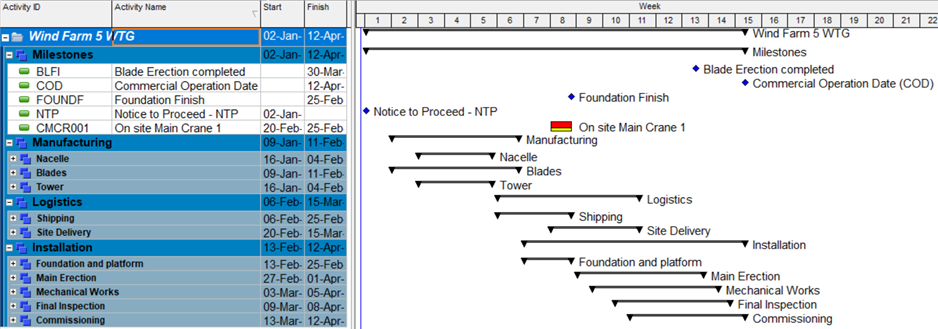
Identify and analyse the critical path of the as-built programme. Since CPM software is not capable of showing the critical path of activities that have already been completed, each activity must be assessed manually by applying common sense and experience.
In order to visualise the critical path and make the analysis easier for third parties to understand, a project Activity Code has been created, the code has been assigned to the activities considered critical, and the colour of the Gantt chart associated with those activities has been modified.
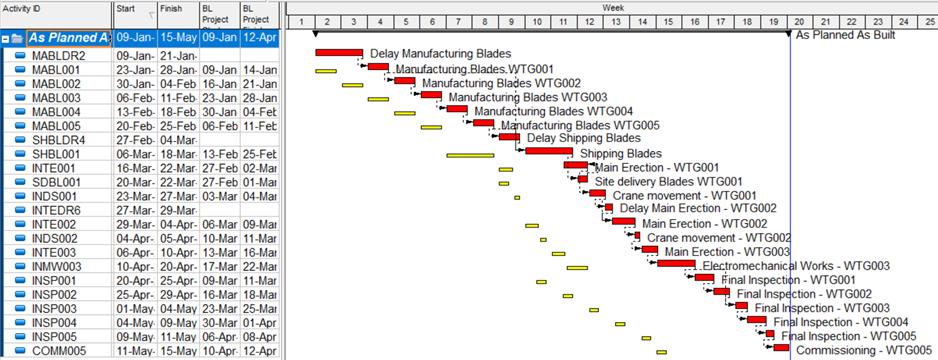
Delays in start, duration extensions and finish delays must be identified by comparison in order to determine significant delay events and mitigations through acceleration or out-of-sequence implementation. Any delay affecting the critical path must be analysed to determine its cause and responsibility.
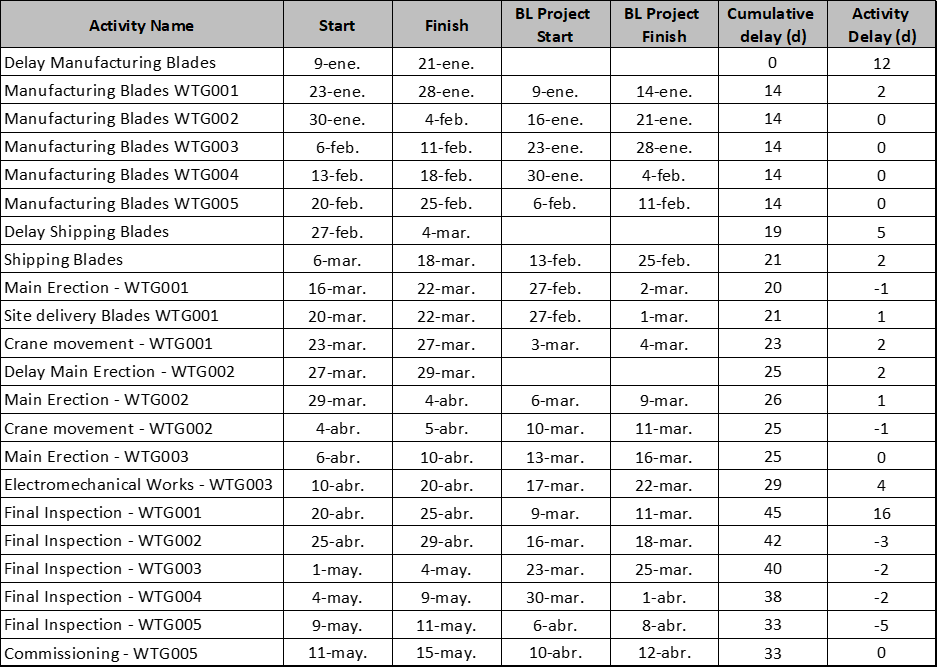
The first delay is in blade manufacturing, which impacted the project critical path by 14 calendar days. The second delay was caused by a delay in blade shipment, which affected the project by 7 days and by 1 additional day in the arrival at the wind farm, all of which is the manufacturer's responsibility. The contractor was delayed because of low productivity and lack of personnel by a total of 9 calendar days, the sum of all installation activity delays, and a 2-day critical path delay was claimed because of strong wind.
In total, the project was delayed by 33 days. According to the analysis performed, 22 days were the responsibility of the manufacturer and therefore excusable and compensable, 9 days were the responsibility of the contractor and therefore non-excusable and non-compensable, and 2 days were caused by force majeure events and therefore excusable but non-compensable.
In this case, a windows analysis would not be necessary because it is a short and simple project.