
Description
The As-Planned vs As-Built method is one of the observational techniques. It consists of comparing what should have happened with what actually happened, measuring the differences between the contractual baseline, or another approved baseline, and the as-built schedule. This method is one of the simplest because it can be carried out through a graphical comparison, such as a Gantt chart, or by comparing the start and finish of activities in a spreadsheet. For projects with a large number of activities and sequence changes during execution, the analysis can become more complicated, requiring the analyst to examine construction logic, activity durations, possible interferences and the causes of each variation.
To carry out a delay analysis using this methodology, the following steps should be followed:
Identify the baseline accepted by both parties and the dates and sequence of execution of the project activities.
Compare the activity dates following the original baseline logic until the first significant delays, where the focus should be placed on the project critical path.
Start delays, duration extensions and finish delays must be identified by comparison in order to determine significant delay events and mitigations through acceleration or out-of-sequence implementation.
Simultaneous delays, whether concurrent delays or pacing delays, must be identified and it must be checked whether they affect the critical path.
Any delay affecting the critical path must be analysed to determine its cause.
Extensions of time granted to the contractor, as well as recovery plans, must be considered because in those cases there may be delays that should not be taken into account.
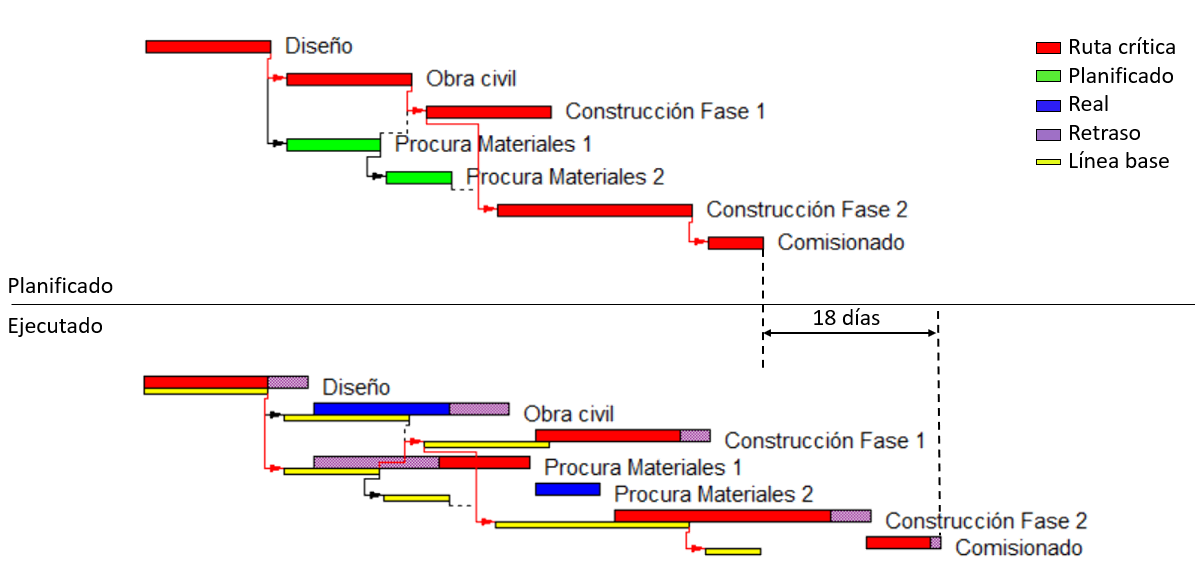
The critical path of the baseline runs from basic and detailed design and engineering, through civil works and construction, and ends with commissioning.
To carry out delay analysis using the As-Planned vs As-Built technique, minimum requirements must be met.
There is reliable data on activity completion and baseline.
The project is simple, with few activities.
There is not much difference between the actual sequence and the planned sequence.

The total project delay is 18 calendar days; however, if we activate the variance column between the activity finish and the project baseline finish, Primavera P6 shows a delay of 15 days. This is because the difference between both dates is calculated considering the working hours of the assigned calendar. To calculate the delay of each activity in calendar days, the simplest and fastest option is to copy the complete activity list, CTRL+A, with the date and baseline date columns activated into Excel and calculate the difference between them.
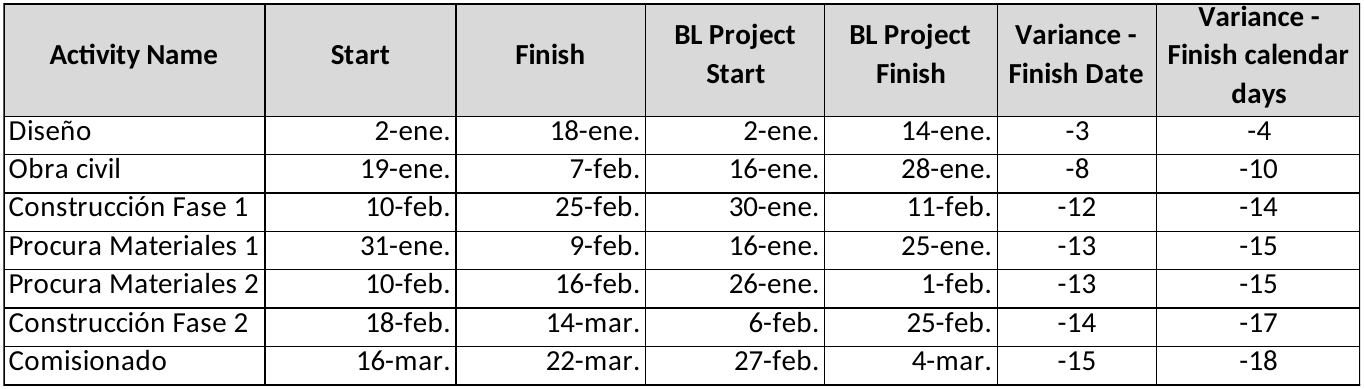
The delays that affected the actual critical path must then be identified and responsibility for them defined.
If we consider the promoter responsible for design and procurement of materials, and the contractor responsible for the remaining activities, and if there was one day of construction delay due to adverse weather, the following conclusion can be reached.
Analysing only the delays of activities on the executed project critical path, the result is that, out of the 18 days of delay, 14 are the promoter's responsibility, excusable and compensable, 3 are the contractor's responsibility, non-excusable and non-compensable, and 1 day is excusable but non-compensable due to force majeure.
Strengths
APAB is a method that is simple to understand for people without experience in construction projects and delay analysis, and easy to present for analysts with little experience. If the delay analysis is too complicated, the result may not be trusted and the chances of claim success may therefore decrease.
It does not require many resources to perform and can reach an acceptable and defensible result in a short period of time. The use of planning software is not necessary.
The documentation required to carry out this analysis is another advantage: only the as-built dates, the agreed planning and the justification for delays on the critical path of the completed project are required.
Weaknesses
The implementation of this methodology is only applicable in simple cases with short project durations and activity sequences very similar to the baseline. For very long projects with major sequence and strategy variations, it will not be possible to obtain a realistic and reliable result.
It is not appropriate for projects with activities that have little total float, or in other words, with several subcritical paths. In addition, changes in the critical path over time cannot be analysed.
It does not consider that changes to the baseline may have been the real cause of the delay rather than specific delay events, and it is not a good method in cases of concurrent delay.
It depends on the knowledge, experience and judgement of the specialist carrying out the analysis.
It ignores the prospective critical paths in contemporary programmes and the critical decisions that may have been made based on them.