
The following chart combines the taxonomic classification made by AACE with the six main SCL methods. Specific implementations can be applied to each method, giving rise to variations within the same method.
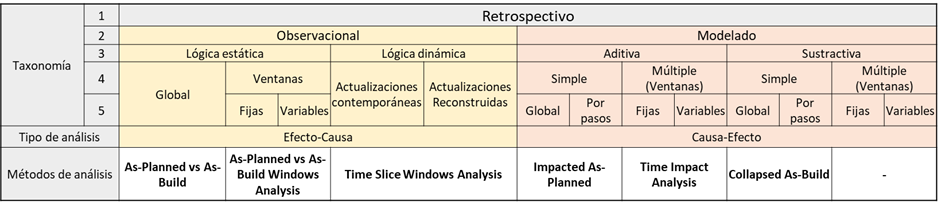
Level 1. Time
The first hierarchical level distinguishes the moment when the analysis is performed, and consists of two branches: prospective and retrospective.
- Prospective analysis - This consists of making an estimate about future events, so the analysis takes place while the project is still in progress and not in a forensic context.
- Retrospective analysis - This is performed once the delay has occurred and its impact is known. The different forms of as-built documentation provide a full advantage in the choice of delay analysis methods under the retrospective approach, because they are the main source of information available for applying the methods.
Level 2. Basic methods
The second hierarchical level contains the basic methods, which consist of two branches: observational and modelled. The main difference is that observational methods are based on comparing schedules, while modelled methods use software such as Primavera P6 or MS Project to calculate and evaluate impacts by creating simulations.
- Observational method - This consists of analysing the schedule without making changes to it.
- Modelled method - Unlike the observational method, this method requires the analyst's intervention beyond simple observation, because simulations must be carried out by inserting or extracting activities in the schedule and comparing the calculated results.
Level 3. Specific methods
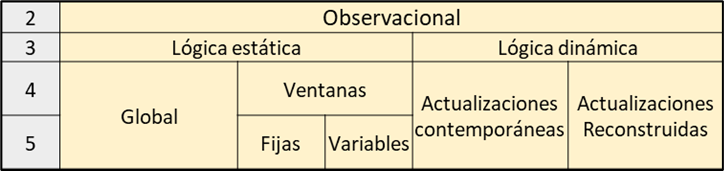
Within the observational method, a distinction is made depending on whether the evaluation considers static logic or dynamic logic.
- Static logic observation - The term static refers to the original planning and therefore to logic that is unchanged from the start of the project. An as-planned schedule is compared with an as-built schedule for the same project.
- Dynamic logic observation - The term dynamic refers to relationships that vary during project execution. Updated schedules are used with work progress and the different sequence or strategy changes that normally differ from the baseline.
 Nivel 3 de la clasificación
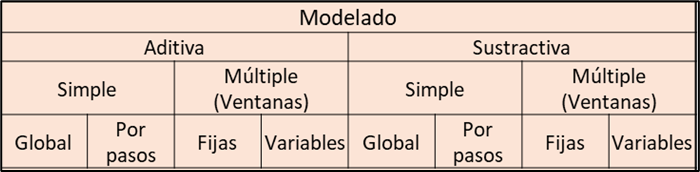
In the modelled method, two distinctions are made depending on whether the delay is added to or subtracted from the schedule when carrying out the analysis.
- Additive modelling - The additive modelling method consists of comparing one schedule with another schedule into which elements have been inserted for the purpose of modelling a specific scenario.
- Subtractive modelling - In the subtractive modelling method, the as-built schedule is compared with another schedule from which elements have been removed for the purpose of modelling a specific scenario.
Level 4 Basic implementations
The fourth hierarchical level is divided into two implementations for each of the level 3 groupings.
The static logic observational method can be implemented globally or periodically. The dynamic logic observational method can be implemented using contemporary updates or updates recreated by the analyst.
 Clasificación metodos observacional
Additive and subtractive modelling methods can be implemented as simple or multiple methods.
- Global or periodic - In global mode, the full project duration is considered as a single period. In periodic mode, the project is segmented into several periods, or windows, and each period is subsequently analysed. Because these windows are based on static logic, they do not consider sequence or strategy changes that occurred during the project.
- Contemporary or recreated updates - These implementations occur in the dynamic logic observational method and both consider the use of updated schedules. The difference is that in contemporary updates each update is evaluated without changing or modifying anything, while in recreated updates the analyst modifies the schedule in order to correct errors, align it with reality or even recreate it completely when no updated schedule exists.
- Simple or multiple - These implementations occur in both additive and subtractive modelling methods. The difference lies in using a single schedule with one sequence or multiple schedules with different updates.
 Clasificación métodos modelados
Level 5. Specific implementations
The last level corresponds to implementations carried out by windows or segments and to simple modelled methods, distinguishing between:
- Fixed periods vs variable periods - In the specific application of fixed periods, these are marked by schedule update dates, usually in regular periods such as months or weeks, and each updated period is analysed in isolation. The variable period implementation establishes new periods marked by changes in the critical path or new schedule revisions.
- Global vs step-by-step - This specific implementation takes place under additive and subtractive modelling methods. In the global application, delays are inserted or extracted all at once, while in the step-by-step application the inclusion or extraction of delays is carried out sequentially, normally from the initial activity to the final activity of the project in the case of insertion, while step-by-step extraction starts with the final activity and ends with the project start activity.