This article has been prepared using the document of the Society of Construction Law, hereinafter SCL, through its Delay and Disruption Protocol. It also uses the International Recommended Practice 29R-03 Forensic Schedule Analysis of the Association for the Advancement of Cost Engineering, hereinafter AACE, and the author's own experience.
A delay analysis method should allow the concurrent determination of three important aspects:
The progress or advancement of the project at the time a delay occurs. The actual progress of the project can make a particular event have a major impact or, on the contrary, have no effect on the contractual completion date.
The natural change of the critical path. Only delays that affect critical activities have an effect on the contractual completion date of the works. However, it must be considered that the critical path can vary during the project life cycle due to work progress and the effects of previous delays.
The effects or impact of the events that occurred. It is common for the contract to specify that the contractor must take action to reduce the effects of the delay regardless of responsibility for it.
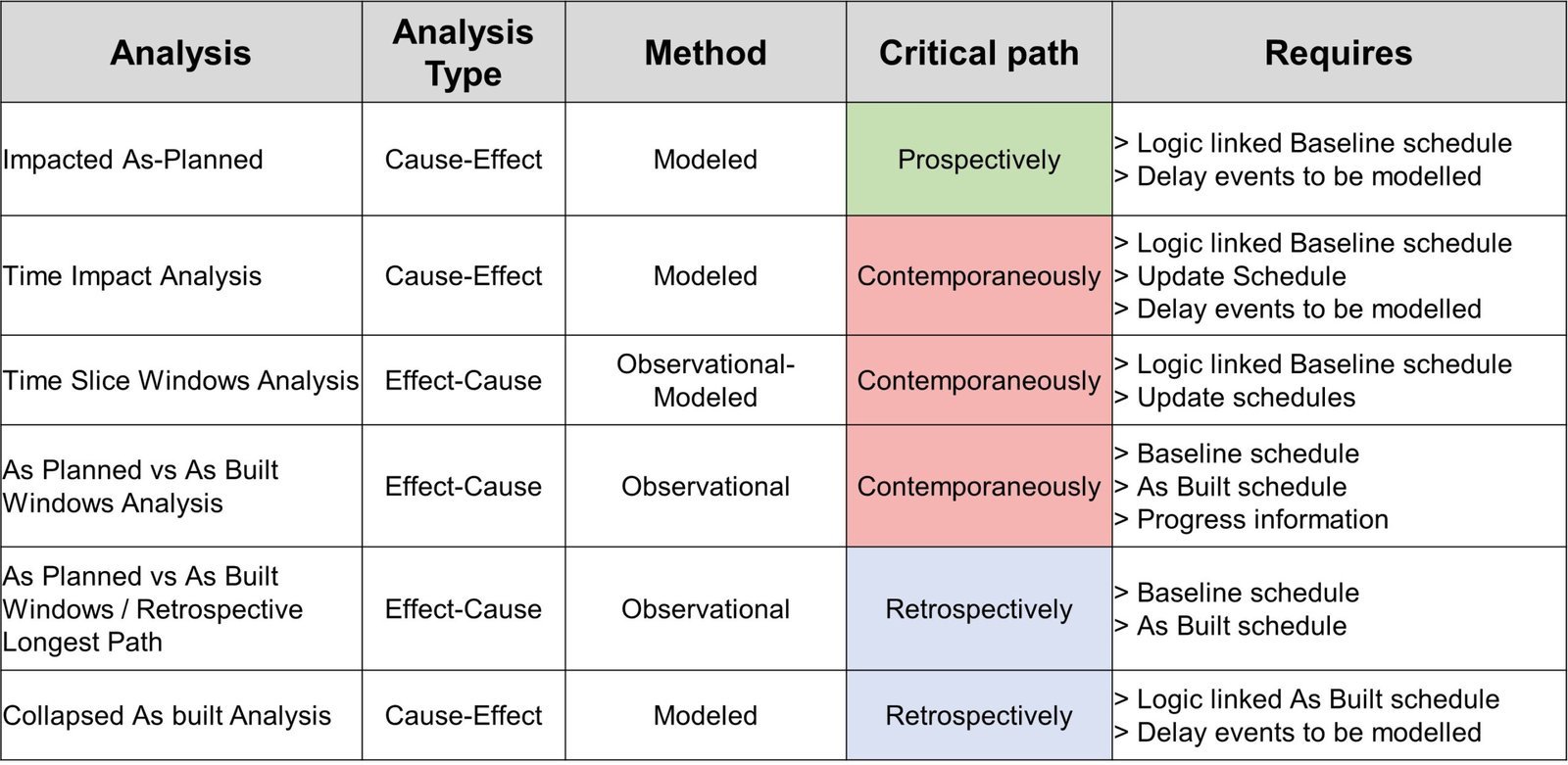
The SCL recognises six delay analysis methods as the most widely used in the industry.
As-Planned vs As-Built (APAB)
Planned versus executed. This is the simplest method. It compares the planning agreed between the parties with the actual start and finish dates of the activities. It does not require the use of software; instead, the analyst must determine the critical path using common sense and experience.
As-Planned vs As-Built Windows Analysis (APABW)
Planned versus executed by windows. In this method, the project is divided into windows configured on the basis of milestones or relevant events, such as changes in the critical path. It is widely used in expert reports because it allows delay to be analysed when there are doubts about the validity of the updates and the baseline. This method does not require planning software, but rather the analyst's experience and common sense.
Time Slice Windows Analysis (TSW)
Time slice analysis. This is an observational windows method in which project updates are required in order to measure delays against the contemporary critical path. The difference compared with As-Planned vs As-Built Windows Analysis is that the logic is dynamic in this case and changes as the project plans are updated.
Impacted As-Planned (IAP)
Impact on the planned programme. This consists of inserting the delay events that occurred during the project into the baseline agreed by the parties and analysing the new completion date.
Time Impact Analysis (TIA)
Time impact analysis. This is a modelled method that uses the updated programmes created during project execution and adds delay events after the update date in order to study changes in the actual critical path for that period.
Collaps As-Built (CAB)
Collapsed as-built. This is one of the most complicated methods to carry out. However, once it has been modelled, it allows the compensable excusable delay, the non-excusable delay and the non-compensable excusable delay to be calculated easily.