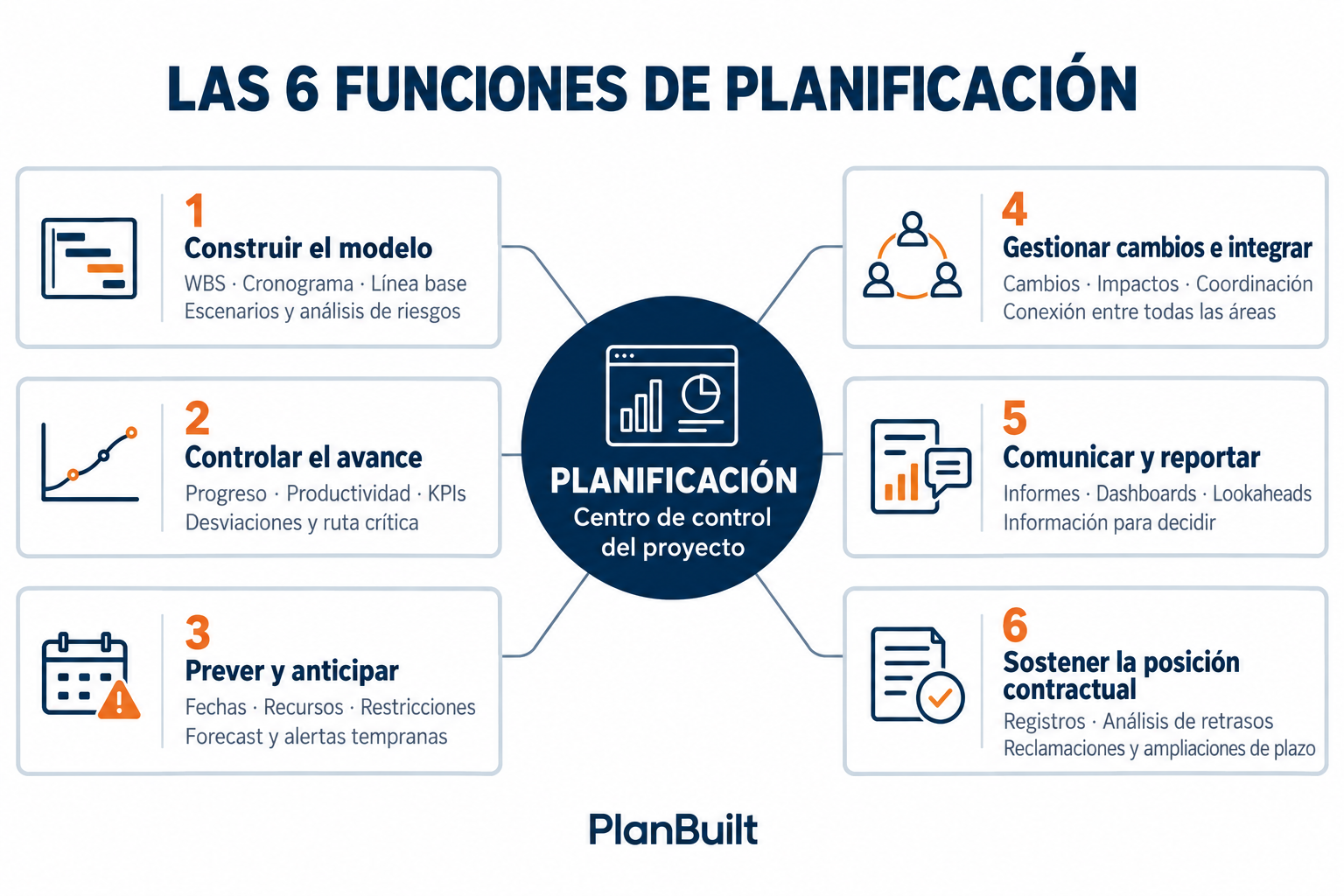
Unfortunately, the most widespread idea about the planning department is that its function is to draw the Gantt chart and update dates. This view confuses one of its tools with its function. In reality, the planning department is the project's control centre: the area that translates the scope into a time model, measures what is happening, anticipates what is going to happen and provides the objective basis for decision-making.
1. Build the project model
This is the starting point and includes structuring the scope through the WBS, developing the schedule with logic and durations, and establishing the contractual baseline against which the entire project will be compared. This model makes it possible to understand not only when the project should finish, but also what drives that date and where there is room for manoeuvre.
Planning also makes it possible to assess scenarios: sequence changes, acceleration, modifications to construction strategy or probabilistic schedule analysis using techniques such as Monte Carlo.
2. Control progress
The department collects physical progress, updates the schedule and compares the real situation with the baseline through:
- S-curves.
- Physical progress.
- Milestones.
- Productivity.
- Resource histograms.
- Earned Value.
- SPI, CPI and other indicators.
- Evolution of the critical path and float.
The objective is not simply to determine how much has been executed, but to identify why a deviation exists and what consequences it will have.
3. Forecast and anticipate
Controlling the past is not enough; the main value of planning lies in anticipating the future. Based on actual productivity, available resources, constraints and the remaining sequence, realistic forecasts are generated for completion dates, resource needs and required productivity.
The forecast must represent what is likely to happen, not simply maintain the dates that the contract wants to show. Early detection of problems is especially valuable because it allows action to be taken while alternatives still exist.
4. Manage changes and integrate the project
No project is executed exactly as planned. Scope changes, delays, new constraints or site decisions have time and economic consequences, and the planning department must calculate the impact and record the events.
This is where one of its most important functions appears: the integrator function. The planner connects:
- Supervisors and site team.
- Quantity Surveyor.
- Cost Controller.
- Contract Manager.
- Engineering.
- Procurement.
- HSE and QA/QC.
- Commissioning.
- Project management.
The schedule thus becomes the common source that connects the whole team.
5. Communicate and report
An analysis or schedule that nobody understands is useless. A central responsibility is to communicate the project status clearly and adapted to each recipient. The objective is not to produce more reports, but information that changes decisions. Planning must transform complex data into information adapted to each level:
- Executive reports.
- Dashboards.
- Lookaheads.
- Progress curves.
- KPIs.
- Variance analysis.
- Recovery scenarios.
6. Support the contractual position
When a time-related conflict appears, the schedule is the main evidence. The planning department provides the basis for claims and extensions of time: it demonstrates what should have happened and when, which activities were affected by an event and what extension of time is due. Without a properly maintained schedule and reliable historical records, defending a contractual position becomes much more difficult.
In summary
Reducing the planning department to the one that makes the schedule is like reducing a pilot to the one who holds the steering wheel. Its real function is to build the project model, measure reality, anticipate deviations, quantify changes, communicate with judgement, integrate the whole team and support the contractual position. When it fulfils all these tasks, the schedule stops being a document updated every month and becomes the backbone of project decision-making.
At PlanBuilt, we develop these planning and project controls functions for engineering and construction projects, both as support for internal teams and through complete planning services.