Introduction
A single project can simultaneously have:
- A schedule showing 60% progress.
- A payment certificate showing 48%.
- An incurred cost equivalent to 75% of the budget.
- A site team that believes more than half of the work is still outstanding.
- Executed variations that have not yet been formally approved.
- Known field delays that do not yet appear in the contractual forecast.
- A management report that presents individually correct data, but data that is inconsistent with itself.
The main challenge of project controls is not simply to produce more information. It is to create a common and sufficiently reliable representation of project status. In that structure, the planner can play a central role as integrator of scope, time, quantities, resources, cost and progress. The schedule can become the time-based and operational axis that connects the work of all those professionals.
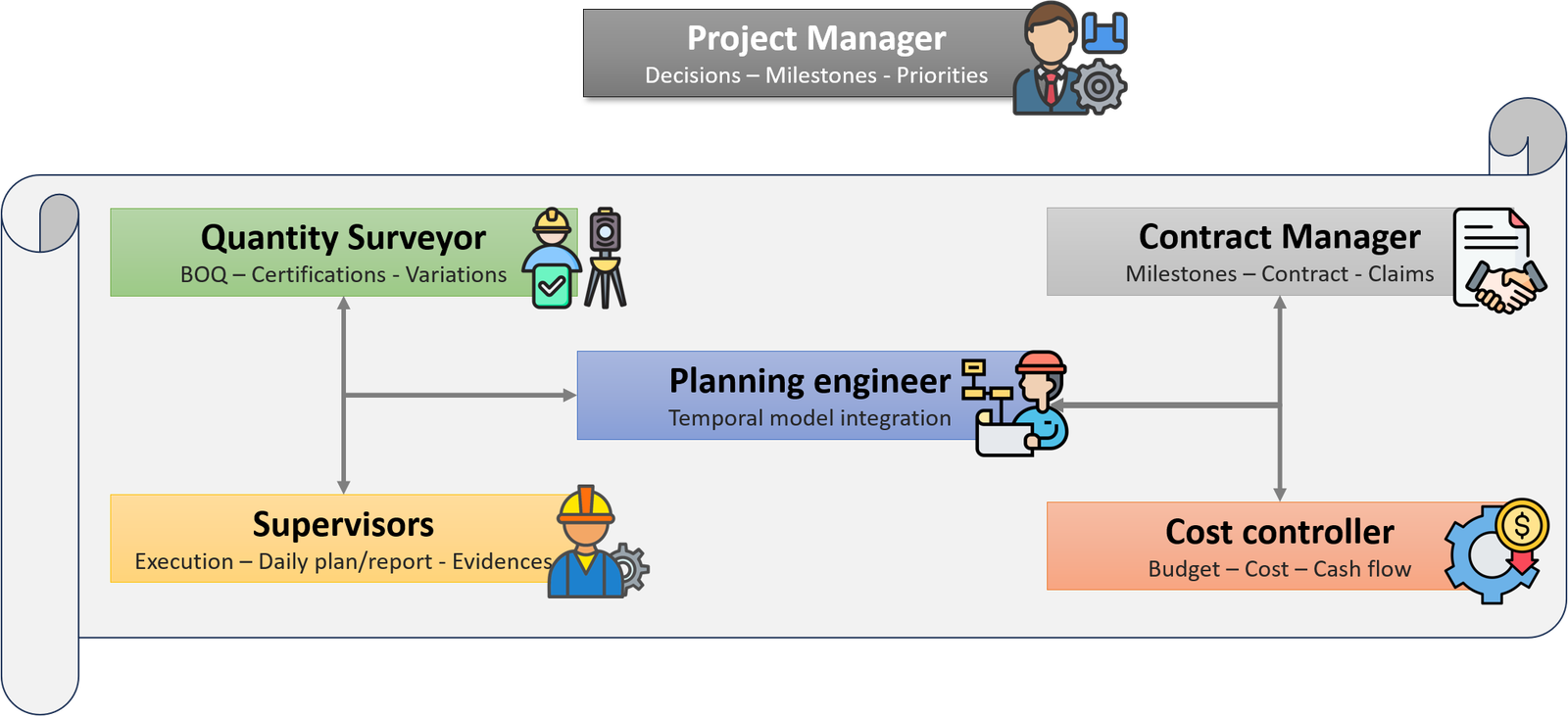
Project management team
What a Quantity Surveyor does
The Quantity Surveyor, or QS, mainly deals with the quantitative and commercial dimension. The role may vary depending on the country, contract type and organisation, but normally includes:
- Quantity measurement.
- Preparation and maintenance of the Bill of Quantities.
- Cost estimating.
- Valuation of executed works.
- Payment certification.
- Variation management.
- Tender review.
In remeasurement projects, the QS is especially relevant because the final amount depends on the quantities actually executed. In lump sum projects, the QS is still necessary to manage variations and claims.
Without a connection to the schedule, the valuation of changes can remain incomplete. A variation may involve not only a greater quantity, but also late access, out-of-sequence work and loss of productivity. For that reason, QS and planner must work closely together.
What a Cost Controller does
The Cost Controller manages the project's internal financial view. While the Quantity Surveyor is usually more connected to measurements, certifications and valuations, the Cost Controller focuses on budget, actual costs, cash flow, accruals and financial reporting.
The Cost Controller creates or maintains the project's cost control structure. The Estimate to Complete calculation adds actual cost to the estimated remaining cost, and this calculation should not be based only on accounting extrapolations. It must consider remaining scope, productivity, variations, delays and other factors. A direct connection with the planner appears here: if the schedule changes, the cost forecast should also change.
What a Contract Manager does
The Contract Manager protects and manages the contractual position of the project. Their work includes contract interpretation, identification of obligations, notice management, contractual correspondence, entitlements and dispute preparation (claims and EoT).
The Contract Manager needs contractual obligations to be represented in the schedule. If the schedule does not contain contractual milestones and third-party responsibility dates, it will be difficult to demonstrate what should have happened and when, whether there was an impact, which activities were affected and therefore what extension of time is due.
When an event appears, the Contract Manager analyses the contractual obligation and responsibility, documentation and strategy. The planner analyses affected activities, dates and critical path. The QS analyses quantities and prices, the Cost Controller analyses incurred and expected cost, and supervisors provide field evidence, interfaces and affected resources. A solid claim comes from integrating all those elements.
What site supervisors do
Supervisors, construction managers, area managers or discipline leads manage physical execution. They are the people who best know the real status of work fronts, access, permits, materials and remaining work. However, their decision horizon is usually short: what will be done tomorrow or this week. The contractual schedule, by contrast, may extend for months or years. The planner's role is to connect both horizons.
The risk of the parallel plan
On many sites there is:
- A contractual programme maintained by the planner.
- A weekly Excel file maintained by construction.
- A pending-items list by discipline.
- A daily plan on a board.
- A separate progress report.
- A constraints register.
- An informal forecast in meetings.
When these systems are not connected, the schedule loses usefulness for construction and the site plan loses contractual traceability.
The planner as project integrator
On complex projects, the planner should be responsible for building and maintaining the integrated time model of the project, not simply updating a schedule. This model must represent what must be executed, in what sequence, what quantities and resources are associated with each activity, the cash-flow forecast, which contractual milestones condition the project, the critical path, what completion forecast results from the current situation, and so on.
The planner does not necessarily generate all the data. Their role is to integrate it within a coherent time structure. One of the most frequent mistakes is to use the planner as an administrative operator who enters percentages and dates in Primavera P6 or Microsoft Project and produces a PDF with the critical path and progress.
The problem is that the schedule can be technically valid and, at the same time, operationally irrelevant. A good planner must perform an integrating function. It is necessary to question whether the reported progress is aligned with the quantities measured by the QS, whether there is pending work not represented, whether the sequence is the one that will really be followed, whether durations are realistic with current productivity, which activities are blocked, and so on.
Why the planner can be the connecting centre of a project
The planner occupies a unique position because every function needs a time dimension.
- The QS needs to know when quantities will be executed and certified.
- The Cost Controller needs to know when costs will be incurred and for how long resources will remain.
- The Contract Manager needs to demonstrate the chronology of events and impacts.
- Supervisors need to know which fronts must be available and what work comes next.
- The Project Manager needs to know which decisions protect the milestones.
The schedule can become the common model that connects activities, areas, quantities, resources, costs, contractual milestones, changes, responsible parties and evidence.
There is a risk in presenting the planner as the owner of all information. The planner should not:
- Approve measurements without authority.
- Validate costs they do not know.
- Interpret the contract unilaterally.
- Replace the supervisor in construction decisions.
- Define the commercial strategy.
- Modify the scope.
- Certify payments.
- Assume responsibilities that belong to others.
Their central role is integration, coordination and consistency. They must ensure that the information from each discipline has visible consequences in the project's time model and that the whole team is aware of it.
Integrated information model
For integration to work, the different functions need a common structure.
Work Breakdown Structure
The WBS organises the scope. It can be structured by:
- Phase.
- Area.
- Discipline.
- System.
- Work Package.
- Contract.
- Deliverable.
The schedule WBS does not have to be identical to the cost structure, but it must be possible to map it to that structure.
Cost Breakdown Structure
The CBS organises the budget and costs.
Bill of Quantities
The BOQ organises measurable and valuable quantities.
Location Breakdown Structure
For construction, it is especially useful to organise by building, level, area, zone, work front or system.
The common code
True integration appears when an activity can be related to:
- A work package.
- A cost code.
- A BOQ item.
- An area.
- A contract.
- A responsible party.
- A change.
- A risk.
Not every system needs to store all the information, but they must be able to exchange it. That interrelationship can be achieved by establishing a well-structured schedule with activity codes that allow grouping and filtering to obtain the information each person needs. The different files from each department feed a single source of truth where everything is interrelated.
Common conflicts between roles
The planner and supervisors
The supervisor may consider that the schedule does not reflect reality. The planner may consider that the supervisor improvises without respecting the sequence. Both may be partly right. The solution is to involve construction in the logic, use areas and quantities, explain to supervisors the importance and usefulness of the schedule, and have the planner reduce the administrative burden and facilitate decision-making on site.
The planner and the Quantity Surveyor
The QS may measure by BOQ while the planner measures by activities. If there is no mapping, the percentage from both will be different. The solution is to define BOQ-activity correspondence, cut-off criteria and treatment of additional quantities.
The planner and the Cost Controller
The planner may work with a monthly calendar while cost control uses accounting periods. There may be differences between execution dates, invoice dates and accrual dates. These differences must be recognised, not artificially eliminated.
The planner and the Contract Manager
The Contract Manager may seek a contractual narrative while the planner must maintain an objective technical analysis. The planner should not manipulate the schedule to favour a claim.
Risks
The model has advantages, but also risks.
Risk 1. Planner overload
If the planner has to collect, clean, integrate and chase all the information, they can become a bottleneck.
Solution:
- Clear responsibilities.
- Structured data.
- Automation.
- Cut-off dates.
- Owners by source.
Risk 2. Lack of authority
The planner may detect inconsistencies without being able to correct them.
Solution:
- Project Manager support.
- Formal governance.
- Escalation.
- Decision register.
Risk 3. Confusion of responsibilities
The planner may end up making decisions that belong to others.
Solution:
- Distinguish integration from approval.
- RACI matrix.
- Clear ownership.
Benefits of correct integration
When planner, QS, Cost Controller, Contract Manager and supervisors work in a connected way, the project obtains:
- More reliable forecast.
- Early detection of deviations.
- Better change control.
- Greater cost recovery.
- Lower contractual exposure.
- Better cash flow.
- Greater schedule credibility.
- Faster decisions.
- Less duplication.
- Better traceability.
- Better documented claims.
- Better coordination between field and office.
The main benefit is not producing a more attractive dashboard. It is reducing the distance between the reality of the site and the information used to make decisions.
The schedule must stop being understood as a monthly document and start being used as the operating model that connects execution, quantities, cost and contract. When this happens, the planner stops being the person who updates dates and becomes an essential part of decision-making.