
Description
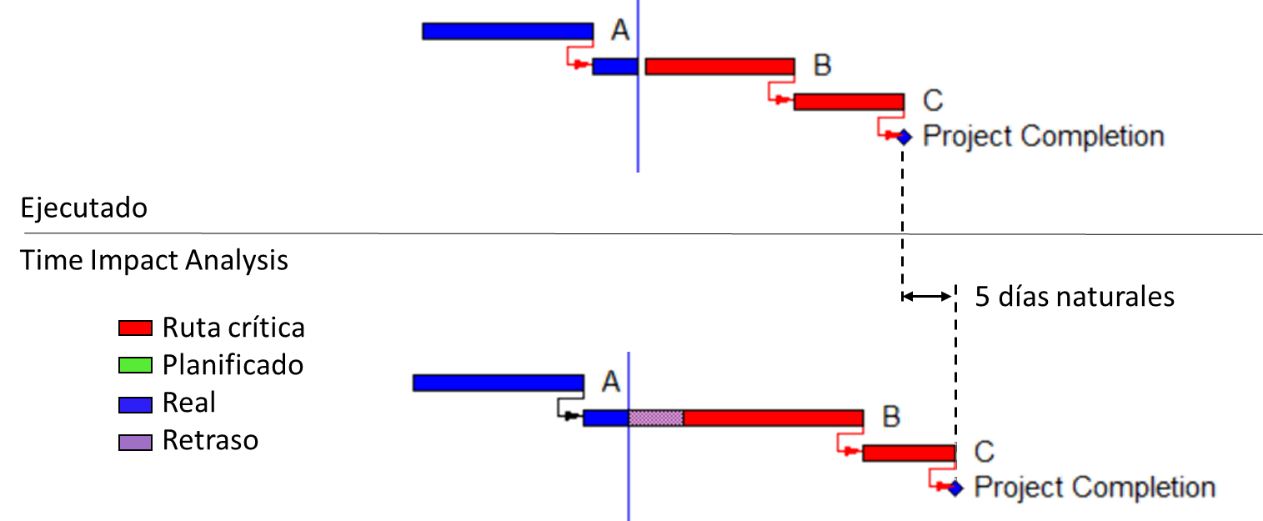
TIA is a modelled technique because it is based on carrying out a simulation by adding delays to a schedule updated to a date before the delay event and recalculating the impact on the critical path with the software.
It is a methodology that can be applied prospectively, which means that a delay analysis can be carried out while the project is still in progress. However, it is more common to carry out the analysis once the project has finished or one of the most important milestones has been reached.
To apply this method, contemporary programmes are required in order to insert the events that occurred during the period under analysis. The intervals normally used are monthly, because this is the most common interval agreed in construction contracts for submitting updates. However, if updates exist, the analysis can be carried out over shorter periods, producing a better analysis.
By using contemporary updates, as in the Time Slice Windows Analysis method, delays can be analysed against the project's actual critical path at that specific moment, provided that the schedule is prepared realistically and not for commercial purposes. This method can be considered as the application of the same system used in Impacted as Planned, but on the monthly updates.
To carry out a delay analysis using this methodology, the following steps should be followed:
- Locate the programmes that will be used to measure progress and delay events.
- Obtain the schedule updated up to the day before the delay event occurred.
- Insert the delay into the schedule, link it to the impacted activities, recalculate the schedule and check whether there is any change in the project finish date.
- Identify the changes in the critical path and in the project finish date.
- Identify who is responsible for the modelled delay events or time gains during the period studied.
- Continue until project completion and add the results of each of the previous periods to obtain the total impact on the project.
Strengths
- It allows prospective analyses to be carried out, which makes it very useful for claiming extensions of time while the project is still in progress.
Weaknesses
- Only specific events are analysed, so it is easy to produce an analysis that favours one of the parties. The number of modelled events has a significant impact on the complexity and cost of implementing the method.
- It is based on the use of fully linked and consistent programmes.
- It requires extensive knowledge of planning software and time in order to produce a valid analysis.
- It is not an appropriate method for preparing expert delay analysis reports.