Description
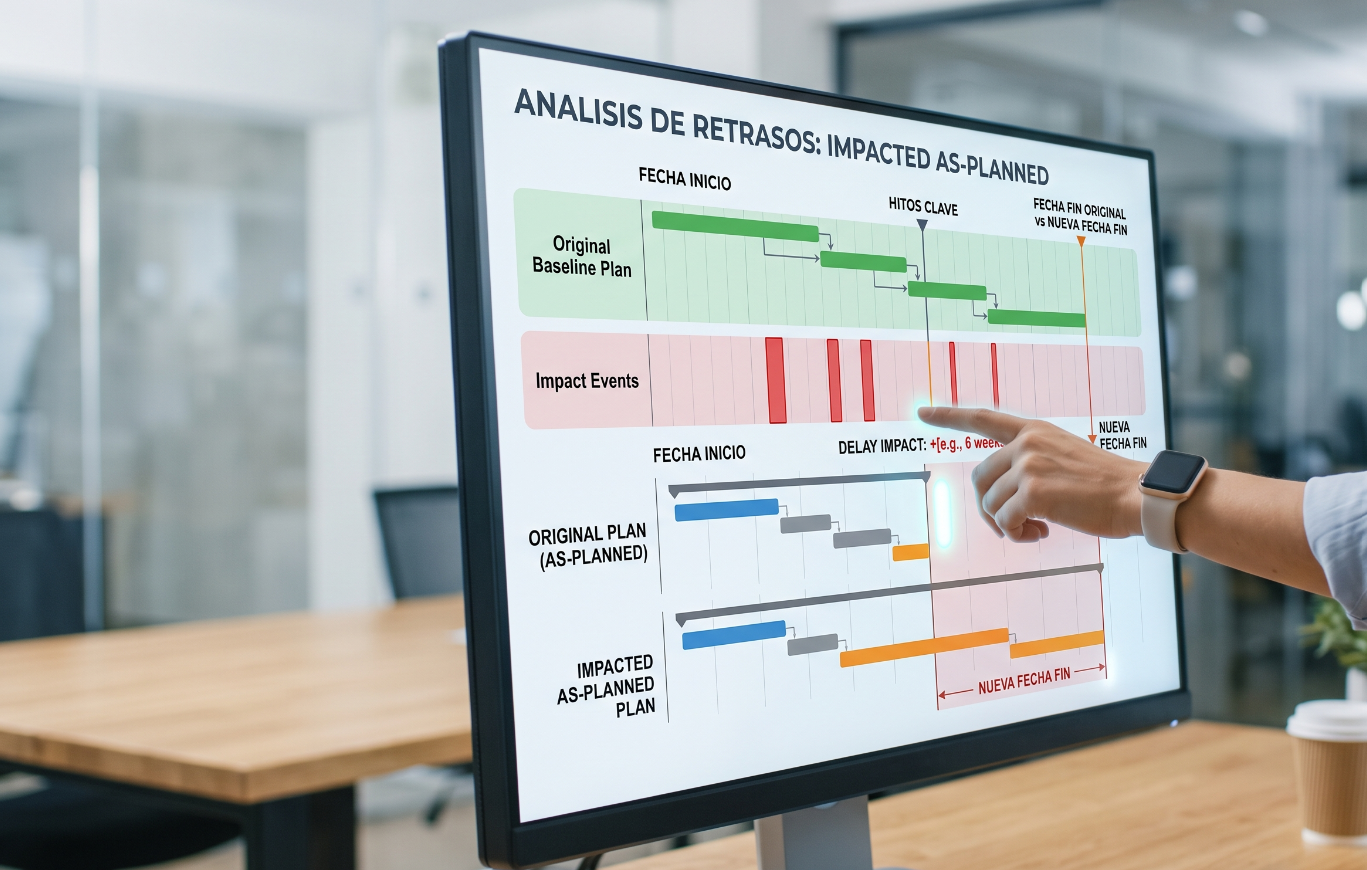
Impacted as Planned is a modelled technique based on creating a simulation by inserting activities into the baseline programme with all activities linked. These added activities represent the delay events that have occurred or the impacts derived from sequence changes.
To carry out a delay analysis using the Impacted as Planned methodology, the following steps should be followed:
- Identify and quantify the delays to be assessed, as well as responsibility for them.
- Select the schedule to be used as the basis for the analysis. If the contractual schedule is not used, the update immediately before the delays to be assessed should be selected.
- Create the activities representing the delay events, recalculate the finish dates and analyse the changes in the project finish dates.
- Set the durations of the added activities to zero to check that there is no change compared with the baseline. This ensures that there is a critical path from the Notice to Proceed to the project completion milestone.
- Compare the project finish dates between the modelled programme and the original programme to determine the impact of the inserted events.
- Model the events that are the contractor's responsibility and those that are the employer's responsibility.
Strengths
- The analysis can be carried out even when information on executed activities is scarce.
- It is very inexpensive and fast because it does not require a large number of specialists analysing documentation to determine what actually happened on the project.
- Because it is a quick and simple method, it can be used as initial justification for an extension of time in a negotiation, taking account of the contract provisions and the limitations of the analysis.
Weaknesses
- If the actual activity sequence is very different from the planned sequence, the analysis may be imprecise and unrealistic.
- A reasonable and correctly linked electronic baseline is required.
- Impacted as Planned does not consider the actual progress of the project or possible replanning.
- After the analysis, the result is a conclusion on the probable effect of the modelled events on the baseline, which may differ from the delay that actually occurred. Its usefulness in disputes and litigation must be assessed against the contract, the available records and the requirements of the proceedings, bearing in mind that it does not incorporate actual progress or replanning.
- The analysis provides a prospective determination of the effect of the delay events, so it may be inconsistent with the actual reality of the project.
- The method can be partial depending on which events are inserted and how they are inserted.
- It cannot be used to determine the existence of concurrent delays.
- It ignores the prospective critical paths in contemporary programmes and the critical decisions that may have been made based on them.