
Pacing
Pacing, or modification of the work rate, occurs when the completion of an activity is consciously and voluntarily delayed. This delay is due to a contemporaneous decision taken because of a concurrent delay affecting another independent activity.
In situations where a delay occurs that is not the contractor's direct responsibility and that in turn creates float in other activities under the contractor's responsibility, the contractor may consider adjusting the pace of work, provided this is compatible with the contract and applicable law. If the decision is made to extend the duration of an activity, this will consume the available float generated by the delay.
To justify that the delay in completing a task is due to voluntary slowing down, it is necessary to give prior notice of that decision. If this slowing down is managed correctly, it can produce cost savings for the contractor and have no impact on the project schedule.
Concurrent delays
A concurrent delay occurs when two or more delays take place simultaneously and have a similar impact on the project. In other words, if either delay had not occurred, the project would still have finished on the same expected date because it would still have been affected by the other delay.
The delay caused by reduction in the work rate, or pacing delay, may coincide with a delay caused by events outside the contractor's responsibility. Its treatment as concurrent delay and its consequences for time and cost must be assessed against the contract, applicable law and the effect of each event on project completion.
Benefits
The contractor's decision to reduce the rate of progress is driven by the objective of maximising profit. However, this can also benefit the owner. The effects on recoverable costs will depend on the applicable contract, responsibility for the events and the losses substantiated.
Disruption
Disruption delay and disruption refers to a decrease in productivity caused by an unexpected event. In the context of a construction project, disruption occurs when the contractor performs work less efficiently than originally planned. This situation may result from various events, such as interruptions to workflow, changes in task sequence or modifications to working hours.
It is important to distinguish between disruption and delay. A delay corresponds to the postponement of the completion date of work, while disruption corresponds to a loss of productivity in carrying out work. However, a delay can cause disruption and vice versa.
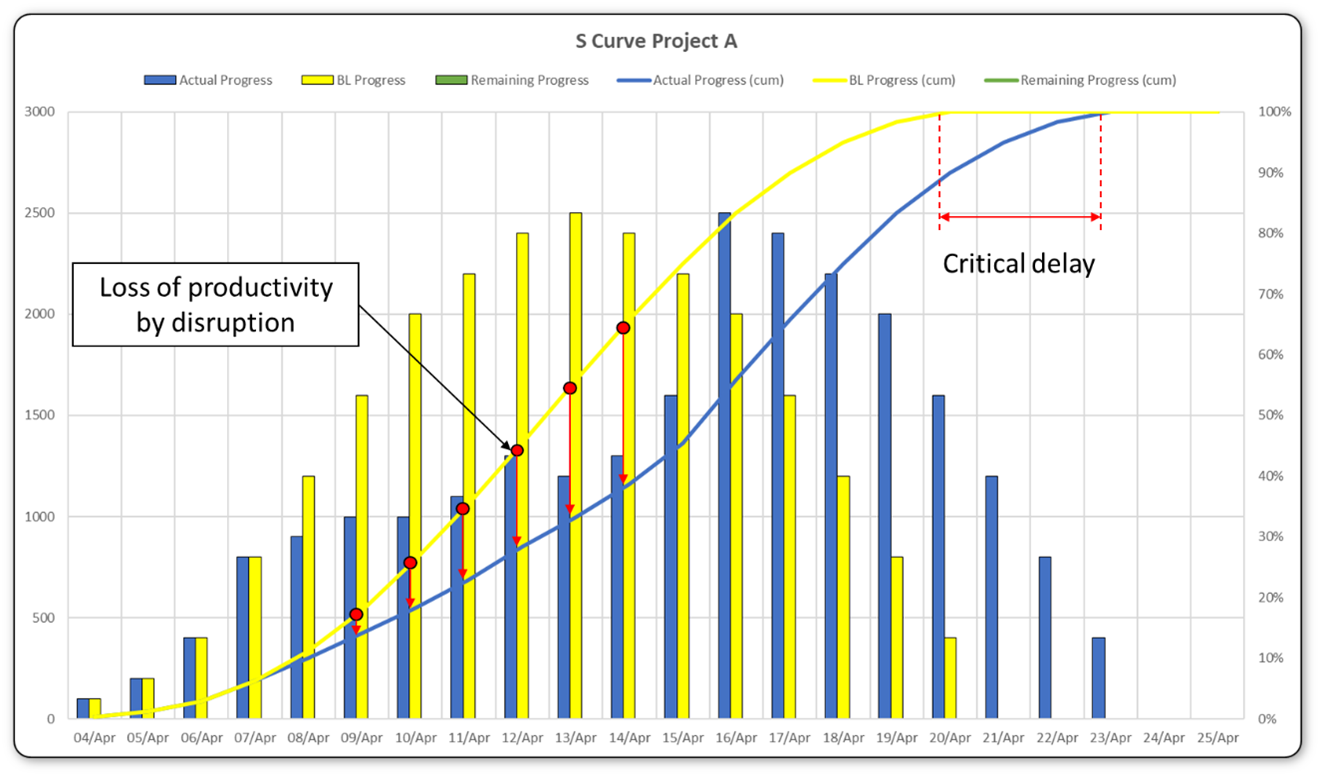
When the cost of labour and machinery exceeds what was planned, a disruption claim is an option to try to recover the costs caused by lost productivity. It is first necessary to consider whether the original plan was realistic. If it was not, it could not be used to measure the effect of the disruption.
Claims
To prove any claim, contemporary and reliable documentary support is required. In the case of a disruption claim, the contractor must provide the following evidence or documentation:
- The progress of the activities that were affected.
- Periods of work impacted and not impacted by the disruptive events.
- Additional equipment and labour implemented on the affected activities.
- Assessment of the difference between planned and executed work, or preferably between unaffected and affected periods.
- The events that generated the loss of productivity.
It is therefore very important to generate and maintain quality contemporary information from the start to the end of the project. A disruption claim is considered difficult to establish, quantify and prove. However, this is mainly due to the inability of contractors to generate and maintain sufficient information during the project.
Loss of productivity is not normally identified when it occurs, but when large differences are found between actual and planned costs. The key to making a successful claim is records, records and records.
Failure by the contractor to comply with the notification provisions stipulated in the contract may result in rejection of the claim. It is good practice to establish a procedure to collect the necessary information and submit the relevant notices. The consequences of the event will always be disputed, but the record of the event should never be in question.
Disruptive events
The events that can impact productivity and generate disruption are diverse and depend on the type of project, management, location and many other factors. Some examples are:
- Irregular work patterns.
- Difficulty accessing the workface.
- Densely populated workspaces.
- Extended working hours.
- Lack of quality supervision.
- Poor communication between workers.
- Carrying out work out of sequence.
- Slow responses to requests for information, or RFIs.
- Shortage or late delivery of materials.
- Change orders
Methodologies
Common methodologies for quantifying loss of productivity, or disruption, in a construction project:
- Earned value analysis.
- Measured mile analysis.
Costs
Works affected by disruptive events are usually subcritical activities outside the critical path and therefore outside a delay analysis. Negotiating an extension of time does not allow recovery of the losses associated with activities affected by disruption.
It is important to understand the difference between a delay and a disruption. A delay is generally used to refer to a postponement of the completion date, which assumes that the activity was part of the critical path. A disruption to progress may or may not cause a delay to project completion, but it will result in higher direct costs.
In simple terms, a recognised extension of time adjusts the contractual completion date and the application of liquidated damages for the recognised period. Compensation for indirect resources and general expenses must be justified separately under the contract. Where higher direct resource costs result from lost productivity, a disruption claim may be pursued, subject to the contract and supporting records.
